
A question for my readers: how can culture help us conceive of the world, in ways that do not prioritize the human?
The Unconcealment of Things
Today I will recount the story of how I followed the lives of two female conservators and their ways of caring for a forgotten object. I began recording the restoration of a Spanish medieval altarpiece in 2024; an object intended for devotional use that now lies at the Harvard Art Museums as an artifact of institutional interest. Over several months, I watched Cristina Morilla and Alex Chipkin bring this object back to life by establishing radical intimacy with their materials and adopting flexible temporalities in their practice. In turn, my theory drew links between humanist and post-humanist scholarship to demonstrate that material agency emerges on relational terms through new definitions of aesthetic feeling. The question i tried to answer was, how can women’s conservation culture(s) help us conceive of the world in ways that do not prioritize humans?
Before I begin, let me give my readers a brief overview of the methodology I used, which will give you an understanding of the lense through which I tell this story. My method consisted of an ethnographic recording of a dialogue (interview) that combined my own sensorial experience with a narrative analysis of how these women carry out their daily work. Through this I portrayed an embodied image that depicted the intersections between political, material and affective dimensions of cultural processes.
Auto-ethnographies are useful tools because their ‘aesthetic and evocative nature fill the gap in existing storylines’ (Ellis, 2011: 3), meaning they create connections between hegemonic narratives and every-day stories. By employing sensory ethnography, this project gives an immersive experience, “through all the senses as well as with the active and reflective mind” (Pink, 2015: 13). In the same way that binaries between masculine critique and feminine labor are dissolved here, so are narratives that allow ‘vision from driving out the other senses’ (Pink, 2015). Through these embodied tools, our method develops post-human sensibilities that bring new temporal experiences and aesthetic feelings onto the page, allowing readers to fully immerse themselves.
Chapter one sets the scene for this narrative, by offering a short rationale on my relationship to these conservators and on my theoretical standpoint, which illustrate my positionality. Then I depict the alterations this altarpiece has gone through over the years which tell the story of traumatization brought on by modernist discourse that led to the disembodiment of the material world. This leads us into a discussion on why conservation practices have been kept secret, demonstrating the connection between patriarchal values and human-centered cultures. Ultimately chapters 5 and 6 argue that we need to rethink our definitions of ‘aesthetic taste’ and ‘technical labor’ if we want to create new visions of collective agency that recenter ‘ugly objects’. The following chapters propose new concepts such as female restoration care and flexible temporalities to broaden our aesthetic sensibilities beyond a capitalist dialectic. Finally, we get an insight into these women’s lives outside of the lab, where their subversive intimacy with objects continues to change the way we relate to the material world.
1. How did I Come to Write This Piece?
When I first walked into the Harvard Art Museums I was greeted by a series of halls decorated with beautiful paintings. I had already prepared the premise of my interview but nevertheless kept coming back to two key questions. Why had I traveled to Boston to interview my mother, and why had I chosen to document the story of a forgotten object. The first explains my positionality as a researcher, and the second my theoretical standpoint. During my youth I was unquestionably fond of my father, a Spanish art historian whose love for art heavily influenced my academic pursuits. When we immigrated to the United States, my mother’s conservation came to a halt —a witty and intelligent woman who used to restore objects was now helping her kids manage the difficulties of migrant dislocation. As my father’s art critique took center stage, two important distinctions solidified in my unconscious mind. The first was the association between art critique and social status, and the second between material labor and feminine care. These circumstances aligned directly with my observations throughout the interviews, which witnessed how two women de-centered humans in their daily practices. As Silvia Winter writes in The Posthuman, humanism is vested in Enlightenment ideals which are fundamentally gendered, able-bodied and racialised (McKittrick, 2015: 13). In this imaginary “European feminists were raised in rational argumentation and detached self irony” (McKittrick, 2015: 32) which is often how women negotiate their place in the art world. A revision of my own biases as a female researcher have inspired me to revisit my mother’s conservation work through a post-humanist lens, which consist of ‘de-linking ourselves from any universalist position, to speak on the concrete actions we are enacting in the material world’ (McKittrick, 2015: 23). My analysis is not merely a practice of cultural critique but rather, a process of gathering things with care (Latour, 2001), which leads me to the following question which is, what is a thing? I draw from Heidegger’s theory of unconcealment to suggests that “the world does not come into being at all through the fact that man first looks upon it” but rather it is man “who is …gathered towards presencing, by that which opens itself” (Heidegger, 1977: 131). In order to become receptive to the things that surround us we should ask “about the happenings in them” which can find themselves in the state of movement or “in the state of quiescence (Ruhe)” (Heidegger, 1970: 44). When things are in Ruhe (stillness) they set a precedent for future becommings (Heidegger, 1970: 53). Therefore, a thing is an essence of past and present temporalities that “necessarily include both object and observer, as well as both sides of the nature/culture and word/world dualisms” (Fox & Alldred, 2017: 19). To reiterate this concept briefly, a thing is an assemblage of human actions and material objects that capture the passing of time and simultaneously shape the future compositions of the world. I have defined the Spanish altarpiece on similar terms, as a thing that is both the cause of human alterations and the natural aging properties of matter, coming together in a state of temporary stillness.
- The Grotesque Object in the Medicalised Imaginary
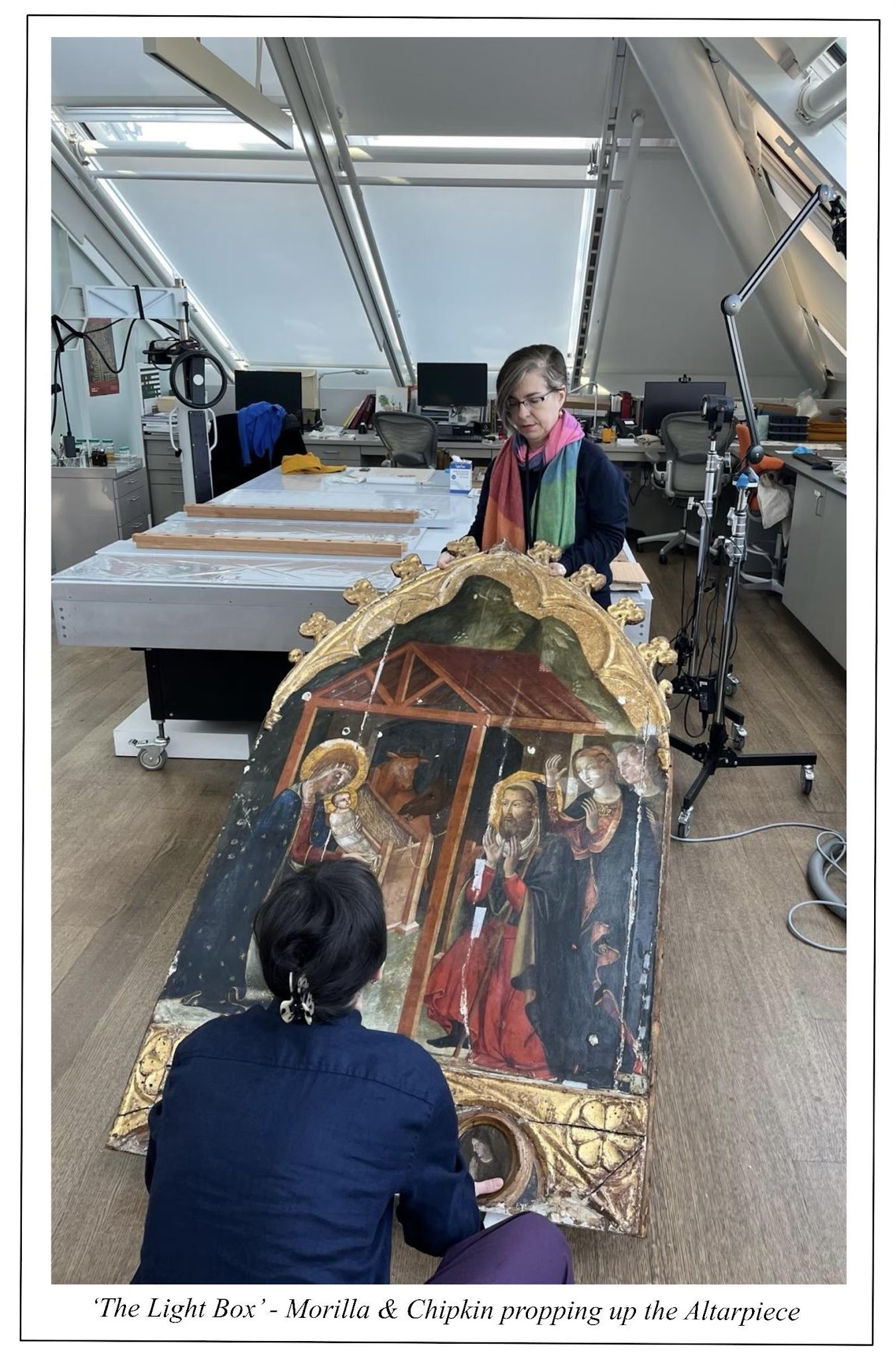
As I walked through the exhibitions I was greeted by a chaotic pastiche of artworks, temporalities and feelings which characterize ‘the new aesthetics’. This concept describes the emergence of atmospheres as the new ways in which people work to create spaces that evoke feelings in the viewer (Böhme, 1993). My body moved through the “exhibition…patterns and practices…reconstituted over time” (Cameron, 2018: 349) with a strange feeling of misfitting or friction (Garland-Thompson, 2011). It was as if I were witnessing the “masks and voices stored up in the imaginary museum of a now global structure” (Jameson, 1984: 65). Although the space produced in me a sense of “contemplative wonder” (Cameron, 2018: 367), I was curious to explore what lay hidden inside the conservation lab. Morilla took me to the uppermost floor where the lab was located, a luminous room with huge windows called “the light box” (Morilla, 2023). This space was created for an ‘aesthetics of transparency’ which is concerned with flattening the objects it surveys by containing them within a medicalised space, thereby erasing any signification that might challenge western values (Hall, 2020: 1). This shift in movement from the pastiche of the museum to the surveillance zone of the lab made me wonder why this religious altarpiece was under observation, and what role these women played in bringing it back to life.
The medieval artwork was decorated with golden leaf and painted with vermillion, lápiz lazuli and green earth pigments. The scene depicted the birth of Jesus Christ —a female virgin holding her newborn child— surrounded by saints who made upward gestures in adoration. Morilla propped up the object and explained, “someone put a thick opaque layer of gypsum in the past to cover the damages” (Morilla, 2024). Due to the rotting wood and the cracked pigments, this object had become a grotesque thing. The work was now a symbol of the ‘monstrous imagination’, or the infant who bears witness to the fearsome power of female creation (Marie-Huet, 1993). In this powerful image, the modern institution and I were witnessing how, “the father-artist has again been erased…while monsters proliferate, like so many mirrors of ourselves” (Marie-H, 1993: 268). This description of the female grotesque signifies the story of modernism; an imagination that deems certain cultural ‘others’ grotesque and where aesthetic labor is given the task of reviving the Zeitgeist “much like doctors take care for their patients” (Morilla, 2023: 00:35:05). The modern cultural imagination had contained religious objects within a secular institution while simultaneously giving foreign female bodies the task of rebuilding them. I wondered whether it was possible to restore the Spanish altarpiece in such a paradoxical situation.

- Interventions, The Story of Conservation
During the laborious process of propping up the altarpiece, Chipkin and Morilla recounted its origins. The object was originally commissioned for a Catalonian church around 1346-47 and later dismembered during the Spanish civil war. This was common for paintings at the time, many of which were only recently recovered (Spanish Ministry of Culture, 2022). In the 20th century, the lower pieces of the altar were again cut off to be resold as Italian art. Spanish art was originally deemed as ‘primitive’ and therefore served little market value (Corbin, 1989). Despite these challenges, Chipkin and Morilla ‘gathered the pieces’ that had been sold or lost over the years (Morilla, 2024: 00:15:08). Their research culminated in a digital reconstruction of the piece which showed the re-assembling of the artwork into “new tiles of relations…consider[ing] the performative effects of their interdependencies” (Cameron, 2018: 351). This method of reconstruction is a ‘palliative form of care’ which seeks to recognize objects as ‘assemblages that are in a constant process of becoming’ (Melkumova- Reynolds, 2019). The conservators treated this object as a living thing, and this was reflected in their historical research, material labor and scientific testing which they combined to develop their restoration strategy.
In the first hour of the interview our discussions about the altarpiece were still operating under a humanist register. We spoke in Bourdieuian terms of taste, meaning on distinctions between high and low culture (Bourdieu, 1984). I asked Chipkin, ‘what do you mean when you talk about taste?. ‘Well…there are certain trends throughout history that you see in paintings, the dealer may have been trying to sell it off as an Italian painting for example’ (Alex, 2024). This sort of thing was typical during the modernist period (1900c) where the bourgeoisie would buy objects according to whether “they [saw] their central values held and reflected” (Jameson, 1984: 44). The logic of the capitalist enterprise had led conservators to make art more palatable —no pun intended— for the market. In the end, one could see “the triumph of invested capital…etched deep into the hearts of the dispossessed” (Adorno & Horkheimer, 1947: 3). The religious object had ‘undergone the complete neutralization of the purifying gaze’ (Bourdieu: 1984: 273) and in turn been reduced to a series of marketable parts that could be resold as images. Any agency this piece held during the medieval period had been revoked due to its Spanish and religious subjectivity.
Modernist values were followed by a postmodernist aesthetic logic that was equally idealist, meaning that paintings were retouched and overpainted so they could appear more ‘authentic’. Previous conservators were concerned with returning this piece to ‘the original hand of the artist’ meaning to the intent of the creator (Chipkin, 2024). This illusion of authenticity suggests that there is such a thing as an original artwork that can be recovered. Morilla and Chipkin showed me these previous interventions through what conservators call ‘cleaning windows’. These entail the use of x-ray technology to uncover tiny layers of paint. The uppermost layer depicted a porcelain-looking figure, made to look clean and polished without a single fault in sight. ‘You can see this one is more like a ghost’ Cristina noted. This was a demonstration of what cultural theorists Adorno and Horkheimer had called the ‘enlightenment as mass deception’ which “scarcely signifies anything more than shining white teeth” (Durkheim & Horkheimer, 1947: 24). The virgin overpainted onto the opaque layer had turned this object into a mere vessel for humanist values to reproduce ‘the logic of human perfectibility’ (Melkumova-Reynolds, 2024: 36). I soon realized that this compulsory ableism projected onto religious objects could be applied to our female bodies too. The humanist Weltbild had forced upon us all —living and dead— an ideology of humanistic perfectionism.
- From Image to Object, Von Weltbild zu Welt-Objekt
In response to this dilemma, I asked the conservators whether they believed that objects have agency. Morilla sighed in a gesture of disappointment, stating that she already knew of such debates regarding the self-organizing qualities of matter (Gell, 1997). Morilla explained that “If it was there, that agency would have been completely destroyed. In this case it is the agency of the market not the object” (Morilla, 2024: 1:13:21). I was hesitant to take her answer literally, but curious to explore whether a post-humanist register would grant a different response. Humanist values reveal a much deeper issue in their interpretation of cultural objects: they see them as images, not as things. Heidegger makes a similar point when he writes that man tries to relate ‘the thing’ to himself by bringing it forward like a Weltbild (a picture of the world) but “the world cannot enter into a picture; there can be no world picture” (Heidegger, 1977: 130). In other words, the world is not a picture that man draws into existence, it is already a living thing imposing itself upon us. Morilla shed further light on this issue.
“I think the way we were taught history was through photographs, so when you go to see a painting you don’t know what it is made of. The way we were taught it was impossible. Tempera has its own language and oil has its own language. If you don’t see through the materials you cannot understand what they are saying” (Morilla, 2023: 00:45:67).
The sensibilities of the conservator are already working in a post-humanist register that views things as assemblages rather than two-dimensional images. In order to move beyond this pictorial perception of the world into a post-humanist mode of thinking we need a “resignification of objects that have been medicalised” (Melkumova-Reynolds, 2024: 3). To unveil the humanist Weltbild is to recenter the language of the material beyond the logic of secular institutions. As the interview continues we will see how these female conservators dismantle this view of humanistic perfectionism through their ability to see the virtue in ugly objects.
5. New Visions, The Breakdown of the Signifying Chain
Conservation used to be a secretive practice until it was professionalized around the 1930’s and became a mostly female dominated profession (Caldararo, 1987). It was not well regarded to think of objects as needing any sort of care, out of fear that they would depreciate in value or that the conservator would lose his status in the art world (Morilla, 2024). When I asked Chipkin and Morilla about this atmosphere of secrecy they explained, “I think it’s almost the nature of conservation, or the beginnings of any kind of solution for damage. It’s a bit of capitalism, it’s a bit of ego…”(Chipkin, 2024: 1:00:01). The conversation continued as follows.
Morilla: Yes, it’s a lot of pride.
Chipkin: The people doing the structural work are usually men and the directors are always men.
Me: I thought it was a mostly female profession?
Chipkin: And it totally is, but most people who do the structural work are men…and a lot of the gatekeepers are men.
Morilla: Men are a lot weaker so eventually…
Me: …they will die off?
[laughter]
Morilla: ¡Qué horror!
Chipkin: Off the record.
The role that masculine pride plays in museum circles and the gatekeeping caused by men has lead these women to finally express their frustration. The mixture of irony and spanish phrases such as “will they die off?” and “¡Que horror!” point towards the breakdown of the humanist ‘signifying chain’ (Hall, 1997). They highlight these women’s ability to vocalize a new culture into existence by reinventing the uses of language. These conversations articulate the intersections between, “labor, sex and the coloniality of power” that shape human and non-human hierarchies (Lugones, 2007, 206). Such barriers preventing female conservators from expanding the art field, simultaneously disable objects from exhibiting their agency. A turn away from humanist thinking must, “make visible our collaboration with systematic racialized gender violence, so as to come to an inevitable recognition of it in our maps of reality” (Lugones, 2007, 207). As the feminist Lugones puts it, we need to radically reimagine our ways of making meaning. At this point, our conversation topic shifted into our personal lives, further illustrating the re-signification process. One particular anecdote struck out to me where the conservators recalled a short encounter they had with a man at a gas station. After proudly declining his offer to pump in gas for them, these women made reflections about their own internalized pride. This anecdote illustrates how we are all becoming “increasingly capable of fashioning representations of our own current experience” (Jameson, 1991: 68). Meaning that new ways of being are rapidly emerging through reflexive thinking. At this point, Morilla and Chipkin retrieved back into their work spaces as if completely engulfed in a new world. Meanwhile, I observed patiently with my newly unveiled post-humanist eyes how they cleaned, carved and cared for the object.
- Care, Radical Intimacy with Objects
Conservators Morilla and Chipkin noted, ‘This kind of treatment is a complete nightmare! We took a huge risk with this piece’ (Cristina, 2024). As I looked closely I could see how the virgin’s visage had not only been overpainted, it had also been cleaned with aggressive solvent, covered with beeswax, and eaten by worms throughout the past restorations. The current cleaning process had revealed a Virgin of four eyes; two from the modernist overpaint, and two from the original paint layer. Hence the name, ‘four eyed Madonna’ that Morilla attributed to the figure. This was the first sign of her ability to establish radical intimacy with objects. She had named her object of affection and was willing to restore it despite the damages. Naming the object of affection is a form of ‘sensual enlivenment that uses affectionate encounters to evoke feelings of identification by reclaiming physical intimacy with the natural world’ (Wilkie & Michael: 2022: 398). Rather than what Sara Ahmed calls ‘happy objects’, onto which humans project their desires for normalcy (Ahmed, 2010: 578) these women deliberately chose ‘ugly objects’ to restore. The following discussion between Chipkin and Morilla continued to reveal their affective ties to the conservation process.
Alex: If you don’t feel an attachment then you don’t feel as inclined to do it justice.
Cristina: You have to value it. If you don’t like it, this is going to be forgotten. You have to want it to shine. And it’s gonna shine.
Alex: And you want it to be cared for in the right way, because this thing has been neglected in a way where you think, man! whoever did this just wanted to get it ready to sell.
Cristina: We want these things to be seen, they are not just objects that we fix and go back into storage.
These conservators felt compelled to make the piece shine, meaning they were the ones being animated by the object. Through this entanglement they were reinterpreting the very notion of “aliveness…giving a relational key to the aliveness of the more than human… community” (Bellacasa, 2019: 401). To say that a grotesque thing deserves to be cared for is to “operate in a particular affective register…against the exclusion of such aesthetic values and the plethora of feelings” (Wilkie & Michael: 2022: 107). This poetics of feeling radically recenters objects in the making of the world in which humans become ‘aesthetic figures’ who have the ability to see “beyond customary or mundane experience, affect, and objects of perception” (Wilkie & Michael, 2022: 105). To describe conservators as aesthetic subjects is to argue that they are committed to understanding the agency of the material world by staying attuned to its language. The conservator assumes full responsibility for her role in sustaining the life of the object and in turn ends up ‘absorbing the aura into one’s own bodily state of being’ (Böhme, 1993:118). You could see this dynamic playing out in Morilla and Chipkin’s expression of worry, desire and guilt for the object to go on display.
Morilla: I feel a bit guilty that we are returning this work of art to the big trauma that it passed.
Me: Why does that worry you?
Morilla: Because we are going to expose the work of art to its worst time. This is kind of Freudian… [uneasy laughter]
Chipkin: It looks bad now and it is going to get worse. It will go through a phase where it gets bad before it gets better.
Morilla: You were asking before about the relationship we have to the work of art, well this relationship is torturous because the appearance of this object is forever on our shoulders…we are on the chopping block.
This dialogue is reminiscent of what the leading disability scholar Tony Siebers calls “trauma art”. He writes, “the aesthetic representation of trauma replays the idea of culture with an added dimension, serving both as the principal sign of the ‘cultural’ and as a way of transforming what ‘culture means’” (Sibers, 2010: 102). These women uncovered the trauma of past interventions to redefine what constitutes as beautiful and ultimately worth caring for. By forcing us to bear witness to the damages done by modernist overpaint I was also reminded of the role we all play as witnesses of their creation. Our ability to feel with objects and reveal their traumatisation despite the guilt, makes this an ethical practice that can change the way the world is built. Such dedication to healing ‘ugly objects’ is indicative of how care is, “about insisting that such a system is never as good as it gets, and about imagining bodies and desires otherwise” (McRuer, 2006: 32). Morilla’s experience of ‘being on the chopping block’ further exemplifies how she absorbs the pain of this object to make the restoration possible. This relational empathy highlights that we too, are being disembodied in a world built upon humanistic values.

- Time, Flexible Temporalities
Secular understandings of time are one of the key factors contributing to disembodiment of religious objects such as this Altarpiece. As the postcolonial thinker Dipesh Chakrabarty puts it, “one cannot think of this plural history of power and provide accounts of the modern political subject…without at the same time radically questioning the nature of historical time” (Chakrabarty, 2000: 10). A similar point made by Heiddegger argues that what is “formally known as past…is mostly only the formerly actual” therefore ”the question ‘what is a thing?’ Is a historical question” (Heidegger, 1970: 52). The conservators exhibited similar critiques in their caring conservation practices while manipulating the state of ruhe that the object found itself in. When conservators clean an overpainted layer or add a piece of wood onto the rotting surface, they are manipulating the lifespan of said piece. Therefore, a caring aesthetic not only grants a theory of the material, but also a theory of the temporal that “actively reconfigures[s the] relationship between nature..technology and practices of living” (Wilkie & Michael, 2022: 109). Chipkins’ meticulous treatment of the wood was an excellent example of these values at work. Her restoration entailed a two-fold process where she identified cracks in the wood, and then inserted wedge shaped pieces with similar aging properties.
Chipkin: This is an irreversibly changed object, so we have to contend with the fact that we cannot get back to the true meaning of the painting.
Morilla: We embrace this not as an original creation of an artist, but as an object that has gone through a lot.
Chipkin: These are wedge shaped pieces that we put in. The adhesive is slightly flexible meaning it has good aging properties.
Morilla: This puzzle she did, all these shapes conforming to the work.
Chipkin: I cut everything by hand. I am a perfectionist about this, but maybe in the future I’ll become more nonchalant.
Morilla: This work of art she did.
Chipkin: There is one kind of satisfaction from making the painting readable but there’s a different kind of satisfaction that comes with fixing it so it can be hung up on a wall, and I think both go hand in hand.
This restoration was made possible by the interaction between care and temporality in Chipkins woodwork. On one hand care entails the “material doing of everyday maintenance and repair” (Bellacasa, 2019: 397) but on the other it is about mediating the passing of time. Her treatment of the wood is a way of “refusing to project one’s conduct onto the opportunistic temporal horizons that characterize the entrepreneurial outlook” (Binkley, 2009: 76). Instead, she uses materials that mimic the temporal qualities of nature —such as the rotting of wood and the eating patterns of worms— which are in a constant cycle of rebirth. She then applies her compulsive attention to detail to construct this meticulous ‘puzzle’, which temporarily expands the life of the object. In turn, she redefines the very meaning of art, which is no longer measured by human taste, but by the temporal qualities of nature and the neuroses of the individuals that ‘fix’ them.

- Celebrating Devotional Objects
These two conservators had expressed their complex relationship to material care through a mixture of cutting edge research and a playful sense of humor. When our interviews came to a close the pair told me about a dinner party they were hosting that evening. ‘Alex!’, Cristina exclaimed, ‘have you figured out if everyone is free on Sunday? I’m going to make us Paella [a traditional Spanish dish]’. The two conservators noted how their party would consist of one rule: everyone would attend dressed as an object. According to Heidegger, the practice of representation means, “to set something before oneself” or to be “sensible of (something)…it is cogitans, which we translate as ‘thinking’” (Heidegger, 1977: 150). To represent is to feel, but also to reflect about what one is feeling. This is exactly what the conservators had been doing all along, thinking about affect in relation to materiality. The use of irony in regards to representation paid a final tribute to these objects at the dinner party.
This act of celebration with objects has a long tradition that emerged in the 1931 Beaux’s Arts ball, where architects attended dressed as their own inventions. In the midst of the Great Depression they “were asked to look past the current circumstances to a brighter future using the theme fête moderne” and “adorn themselves with the technology of the age” (Giermann, 2015:). William F. Lamb dressed as the Empire State Building and Arthur j. Arwine as the heating boiler to name a few. The breakdown of capitalism provided opportunities to relate to objects beyond the logic of consumption and created a space where humans were now the ones being cared for.
These women performed a similar practice which can be described as a form of secular ritual. As Tony Siebers notes in his book, Disability Aesthetics, the term ‘ritual’ has been re-signified in recent years (Siebers, 2010). Drawing from Emile Durkheim he defines ‘aesthetic rituals’ as “symbols of community disguised as sacred ideas. They express a desire for social cohesion, creating a form of solidarity without consensus” (Siebers, 2010: 106). These object-centered fêtes pay tribute to the material world through a subversive form of solidarity that relies on humor. The practice often uses “bodily symbols” as a form of expression (Siebers, 2010: 106). Some of the phrases that had come up in our discussions were ‘cultural taste’, ‘the hands of the artist’ and ‘the head on the chopping block’ . These are all part of the embodied practice that the conservators used to express their affection with objects. Moreover they contributed to the redefinition of culture based on the sensorial devotion for a non-human world. This form of collective representation is ultimately a way of acknowledging that “mysterious darkness becomes both for science and aesthetic engagement akin” (De la Bellacasa, 2019: 395). Both within and outside of scientific discourse, humans have to grapple with the mystical qualities of matter. The female conservators, committed to their role as aesthetic figures, are negotiating these boundaries to create a dialogue between the two. Their ability to touch, see and relate on material terms allows for the unconcealment of a new ethics of living.

- Conclusion
The goal of this story was not only to affirm that conservation practices are an important category within aesthetic culture. Rather, it was to explore a fundamental binary between critique/labor that restricts our ability to see beyond symbolic and dialectical visions of the world. Such binaries emerge from the humanist Weltbild which is fundamentally gendered, racialized and able bodied, putting female conservators in a unique position to address their intersectional roots. Conservators Chipkin and Morilla have found ways to establish radical intimacy with the Spanish altarpiece and employ flexible temporalities to revive its agency within a secular context. Ultimately their ability to respect the subjectivity of objects and devise new methods for their treatment beyond a curitative imperative reveal potential avenues for dismantling the ‘box’ of humanist thinking. As aesthetic figures we are not only the ones healing the ecosystem but in the end, we too are the ones being healed.
Bibliography:
Ahmed, S. (2010) Killing Joy: Feminism and the History of Happiness. Signs, 35(3), 571–594. Available at: https://doi.org/10.1086/648513
Binkley, S. (2009) The work of neoliberal governmentality: Temporality and ethical substance in the tale of two dads. Foucault studies. 1(6), pp. 60–78. Available at:10.22439/fs.v0i0.2472.
Böhme, G. (1993) Atmosphere as the Fundamental Concept of a New Aesthetics. Thesis eleven, 36(1), pp.113-126.
Bourdieu, P. (1984) ‘The Sense of Distinction’, in Distinction: A Social Critique of the Judgment of Taste. London: Routledge: 1(1), pp. 260-318.
Caldararo, N. L. (1987) An Outline History of Conservation in Archaeology and Anthropology as Presented Through Its Publications. Journal of the American Institute for Conservation, 26(2), pp. 85–104. Available at: 10.1179/019713687806027889.
Cameron, F. R. (2018) ‘Posthuman museum practices’. In Braidotti, R. and Hlavajova, Posthuman Glossary. London: Bloomsbury, 1(35), pp. 349-352.
Chakrabarty, D. (2000) Provincializing Europe : postcolonial thought and historical difference . Princeton, N.J. :Princeton University Press.
Ellis, C. (2011) Autoethnography: An Overview. Forum Qualitative Sozialforschung / Forum: Qualitative Social Research. 12 (1), pp 1-13. Available at: doi:10.17169/fqs-12.1.1589.
Fisher, K. (2022) ‘Decolonizing rivers in Aotearoa New Zealand’. In Lee, E. and Evans, J. eds. Indigenous Women’s Voices: 20 Years on from Linda Tuhiwai Smith’s Decolonizing Methodologies. London: Bloomsbury, pp. 17-32.
Garland-Thomson, R. (2011) Misfits: A Feminist Materialist Disability Concept. Hypatia: JStor. 26(3), pp. 591-609. Available at: http://www.jstor.org/stable/23016570. [Accessed 18 May 2024]
Gell, A. (1998) Art and Agency An Anthropological Theory. Oxford: Oxford University Press. 1(1), pp 1-259.
Giermann, H. (2015) Architects Dressed As Buildings at the 1931 Beaux Arts Ball. Arch Daily. [online]. Available at: https://www.archdaily.com/599743/architects-dressed-as-buildings-at-the-1931-beaux-arts-ball
Hall, R. (2015) Terror and The Female Grotesque: Introducing Full-Body Scanners to US Airports. In: R.E. Dubrofsky & S. Magnet (eds.). Feminist surveillance studies. Durham :, Duke University Press. pp. 127–149.
Hall, S. (1997) Race, The Floating Signifier. Online Transcript. Northampton: Media Education Foundation. Available at: https://www.mediaed.org/transcripts/Stuart-Hall-Race-the-Floating-Signifier-Transcript.pdf
Heidegger, M (1977) ‘The Question Concerning Technology, and other essays’, in Martin Heidegger, basic writings. Edited by David Farrell Krell. New York: Harper and Row. 1(1), pp. 1-155.
Hiedegger, M. (1970) What is a thing?. Chicago: Henry Regnery Company. [online] Available at: https://static1.squarespace.com/static/5577cb2ae4b049f9488d4c04/t/5637e14fe4b07fb2f7b9a6e6/1446502735298/heidegger_1967.pdf [Accessed: 11-May-2024]
Horkheimer, M. & Adorno, W. T. (2002) ‘The Culture Industry: Enlightenment as Mass Deception’ in, Dialectic of Enlightenment. Redwood City: Stanford University Press. Available from: ProQuest Central. (Accessed: 11 May 2024)
Latour, B. (2004) Has critique run out of steam?From Matters of Fact to Matters of Concern. Critical Inquiry. Chicago: University of Chicago. 30(2), 225-228.
Lugones, M. (2007) Heterosexualism and the Colonial / Modern Gender System. Hypatia. Writing Against Heterosexism, Vol. 22(1), pp. 186-209
Marie-Hélène, H. (1993) Monstrous Imagination. Cambridge: Harvard University Press. 1(1), pp. 1-344.
McRuer, R. (2006) ‘Introduction: Compulsory Able-bodiedness and Queer/Disabled Existence’ in, Crip theory: cultural signs of queerness and disability [electronic resource]. Ed. 1st. New York: New York University Press. Available at: doi:10.18574/nyu/9780814759868.
McKittrick, K. (2015) ‘Sylvia Wynter: What Does It Mean to Be Human? // Walter D. Mignolo’ In, K. McKittrick. Sylvia Wynter: on being human as praxis. Durham: Duke University Press. [online resource]. Pp. 1-305.
Melkumova-Reynolds, J. (2024) ‘On Crutches, Choreography and (Crip) Care: Curative Objects and Palliative Things’, in Two Performance Pieces. In: Woolley, D., Johnstone, F., Sampson, E. and Chambers, P. (Eds). Wearable Objects and Curative Things: Materialist Approaches to the Intersections of Fashion, Art, Health and Medicine. London: Palgrave Macmillan. Pp. 1-13
Ministerio de Cultura y Deporte (2022) Informe provisional sobre las obras de arte del museo del prado procedentes de la comisaría general del servicio de defensa del patrimonio artístico nacional y/o de la junta de incautación y protección del patrimonio artístico. Madrid: Gobierno de España. [online]. Available at: https://content3.cdnprado.net/doclinks/pdf/museo/coleccion/informe-incautacion.pdf
Pink, S. (2015) ‘Situating Sensory Ethnography from Academia To Intervention’ In, Doing sensory ethnography. London : SAGE Publications 2nd edition. Pp. 1-216 pages.
Puig de la Bellacasa, M. (2019). Re-animating soils: Transforming human–soil affections through science, culture and community. The Sociological Review, 67(2), pp. 391-407. Available at: https://doi.org/10.1177/0038026119830601
Siebers, T. (2010) Disability aesthetics. Michigan: Michigan University Press. 1(1), pp. 1-26.